Although only Sam, Yisheng and Aaron showed up, it was a fruitful discussion. S. told us that she borrowed it from Queenstown Library, which had a display for queer YA post-377A. Say what you will about the repeal, but the effects are palpable. YS noted that the novel is part of a wave to introduce Asian history to the western world; and admired it for its vividness and innovation as if watching historical drama on TV. It’s precisely because its dramalike action that A. didn’t like it, bringing the cliff scene and the ending scene as examples of cliches in c-drama.
A. also didn’t like the awkward writing—
“Feels something at the pit of the stomach. It was angry.”
“He never felt layers of feelings before. Love and hate.”
—although A. also noted that there are some brilliant metaphors like “offended like a wet cat.”
We also discussed:
-the significance of ghosts (is there meaning? What are their functions? Why do they surround Ouyang?);
-the sense of manhood (Xu Da, Ouyang, Isen, Lord Wang); why are there so many unlikeable male characters?
-sexuality (what does it mean to be forcibly castrated for Ouyang and Zhu? Why did the lack of an appendage prevent Ouyang-Isen from romantic love but aid in Zhu-Ma’s relationship?);
-is there misgendering of Zhu? or is it fluidity? S. informed us that the author identifies with being nonbinary (they/them)
-gender- is it possible to reimagine women in power in a patriarchy?
-ableism? Ouyang’s pov that a disabled person is worse than death.
-love: sequences between Ma and Zhu are good
-violence – is violence necessary for social progress? Is fighting for survival better than fighting for ideology? Are they the same?
-ethics- as Zhu makes bigger and bigger gamble to survive and thrive, how much of humanity is one willing to sacrifice to get power?
The meeting on 20 July was attended by Sharad (moderating), Aaron, and Lip Sin.
Lip Sin noted that from interviews the author had given, it sounded as though this book was a project long in the making. Aaron added that it seemed as if the book were written in bits and pieces across a long period of time.
Aaron did not like the book: he found the writing pretentious and the author’s aims unclear. He thought the author did not interrogate his identity (white-passing Asian) or his desires (seemingly only attracted to white men) deeply enough. This led Aaron to think that the author was avoiding important issues on purpose. For example, he pointed to how the author wrote a lot about sex but did not say anything about STIs or sexual health.
Sharad was ambivalent about the book. He found the absence of an emphasis on diversity and race striking, even refreshing, since it seems to have become an obligatory fixture of contemporary gay writing. He thought the book did a good job of using gay bars as settings to explore the author’s relation to and growth as a gay man – sometimes as spaces of “false intimacy”, sometimes as places to just “be gay”, sometimes a place of longing for transcendence. He thought the author captured nicely that gay bars weren’t places of relaxation, but a place of a tension where bodies “orbit” around each other. Ultimately, however, Sharad found the book boring because the different places in the book weren’t distinct enough and so working through those different sites was a slog.
Aging: Sharad thought the description of Blackpool made it sound fascinating. Apparently, it is a heavily disadvantaged area where a lot of young people have moved away from, so its gay bars are filled with motley middle-aged people.
Consent culture: Sharad noticed that the author seemed to be nostalgic for a gay bar culture that put less emphasis on safety and consent, and instead reveled in a more open-ended, sleazy past. For the author, getting manhandled as a youth and then growing up and doing that to new youths seemed to be a natural cycle, just what you do as a gay man. As opposed to Lin’s insouciance over consent, Aaron brought up his own experience of being groped in saunas and felt violated and repulsed. Clearly, the author needs to rethink his idea of non-consent.
Intergenerational Sex: Aaron thought the author’s descriptions of intergenerational sex, of sex with guys 20 years his junior, came across as taking advantage of younger people. This is an area that the author neglects to ruminate over too.
This event was attended by six people: Sharad (mod), Aaron, Sam, Yen, Ron, and Dorcas. This was a rare session where nobody disliked the book.
1. What did you like or dislike in it?
Sam: “OMG” is what I would say, everyone should read it. A whole world I wasn’t exposed to.
Aaron: Agreed, very original, very different worldview than I know of, never seen such characters; some of the psychological aspects of being trans are fleshed out so deeply, like nothing I’ve read in the canon. Liked the racial aspect because they have an Asian American; self-reflexive: the white gaze but the author is constantly acknowledging that this was a white trans women’s POV. But sometimes its preachy and propagandistic because the author is putting her own views in characters’ mouths
Yen: Liked that a world was opened to me, but I didn’t feel preached to. Liked the voice, writing style, and its comfort with not having a neat resolution. I would recommend to someone who hasn’t had kids yet but considering it. But a problem (more about the market and marketing) is a penchant for the sensational. Where is the unsensational treatment of queer life? Everything has to be negotiated. Sometimes it’s the most boring things that make up queer life, but there’s usually no room for boredom in our representations, something baity about it.
Ron: about identity – even Katrina was Jewish and Chinese, lot about searching and understanding; things never end; character development. Maybe could have been a little shorter
Sharad: Social constructivist sensibility since there was no appeal to essences or identities that were always just there and had to be discovered – characters were always making and remaking their identities with others.
2. Scenes, themes, or ideas that stood out
Ron: It was like a scene from Friends, 80s-90s references. Like the first episode of Friends had Ross married to Carol, a lesbian
Aaron: Doesn’t Sex and the City problem happen to everyone, including cis men?
Sam: Interested in commentary about women and womanhood, noted the line “She would happily cheer on any other woman who flaunted her orbital ridge in the name of challenging cis-normative beauty standards, but she would have the first available misogynist dick of a surgeon burr her skull Barbie smooth.” There was lots of violent sex but this was not sensationalized.
Yen: The book was not afraid to be ugly – for eg: Amy crying and talking about poppers removing inhibitions, about vulnerability and needing substances. It also managed to deal with tragedy without turning into a thing – eg: mentioning Wim Hoff and then Reese walking into the ocean in a tableau-esque fashion
Ron: Surprised poppers were mentioned and that the NLB carried this book anyway
Dorcas: What are poppers? [Poppers 101 followed]
3. The Ending
Dorcas: you always want a happy ending, but I liked that they left it open-ended
Sam: I liked the ending a lot; also, I wanted to know whether they went ahead; I would have liked a one-off chapter
4. Characters commentary
Aaron: Nice that a non-white character included, but not accurate. Like no Asian mom would approve the triad, like Katrina’s mom did!
Ron: People who leave the country might get more liberal
Sharad: Karina’s mom was a hippie in California at this point
Sam: Actually, the people I know who go abroad get more conservative
Aaron: Reese comes up with flippant statements eg: “women love a fascist” is a quotation from sylvia plath; difference between camp and being flippant, this was definitely flippant
Dorcas: really liked Katrina’s convo with Reese about why she wants to be a mother, and Reese’s response that it’s not a question cis women are expected to answer
Ron: Don’t know why Reese would let herself be treated like that, especially since I’m imagining Stanley to be fat and ugly. Makes me angry and sad
Dorcas: What if he was attractive and suave?
Ron: Still no!
Ron: Each character had their own personality
Aaron: To me, all three characters spoke with the voice of the author
Sam: Liked convos between Katherine and Reese, since it was between a trans woman and mixed-race person
Sam, Ron, Sharad: Did not like Reese’s boyfriends
Sam: Retrospectively, there was so much information, you get it as you pass by without noticing
Dorcas: But conversations were very natural and flow.
Aaron: But were they moving through issues too fast?
Ron: No, this was just centering trans people
Yen: the issues were part of the landscape, feels like her life
Sam: it’s like any life, it’s never about one thing
Death in Venice is the classic gay novel par excellence, at least of the late 19th/early 20th century, the era of the novel. So said NYT in 1999 and really for me, it also crystallizes the themes, narrative techniques, and atmosphere that have characterized gay literature for most of the twentieth century: angst, longing, aestheticism, unequal desire, discovery, self-denial. Man meets boy. Man falls in love but doesn’t quite know what he’s feeling or what to do. Some sort of sublimated consummation. Awkward tragedy ensues, or at least there is distinctly no happily ever after. Call Me By Your Name is essentially a retelling of this tale as old as Plato or Hafez, but clearly indebted to Thomas Mann. While considering other classics – Gide’s The Immoralist, Musil’s Young Törless, Isherwood’s A Single Man, Genet’s Our Lady of Flowers, even Proust – I decided to have Death in Venice stand in for them. I’ve probably, inevitably, been influenced by the Visconti film, with Björn Andrésen as Tadzio, the quattrocento pale and curly-haired ephebic muse, with the focus alternating between his face and his crotch.
Mann, for what it’s worth, claimed his own aim was to narrate the protagonist’s – Aschenbach’s – fall from artistic inspiration, having been inspired by Goethe’s own fall due to his infatuation with a teenage girl: “In Death in Venice I wanted to present a man who at the summit of success, honor, fame, and fortune finds no refuge in art but instead runs aground, physically and psychologically, on an insurmountable passion. . . . Only to make the plunge from the summit into the depths appear as fateful as possible did I choose for my hero homosexual love.”[1] This intensely ambivalent aestheticization of desire on the one hand, and romanticization of art on the other has often been at the heart of queer literary identity. I could and can identify with the brokenness and persecution both internal and external that torment Aschenbach, as well as the revelling in escapist, apocalyptic delight that Tadzio brings.
Michael Cunningham in his introduction to Heim’s 2004 translation writes: “We can probably tell a good deal about an era by its most prominent literary characters. The twentieth century gave us Leopold Bloom, Clarissa Dalloway, Humbert Humbert, and Jay Gatsby, among others, and it gave us Gustav von Aschenbach… Aschenbach is, to me at least, the most devastating of the lot… He is descended from King Lear, the most glorious of all misguided spirits… Here is an Aschenbach who is more clearly and unavoidably all of us, who wants more than life is willing to provide, whose defeat is so bound up with his heroism that the two can’t be easily separated. That may or may not be exactly what Mann had in mind. There’s no way of knowing.”
Chabon (“Shay-bon”) will forever be the writer my younger self wished he could have been – brat pack, discovered young (with a $155,000 advance for this book!), charmingly lyrical prose, genuinely self-effacing. Yet so full of ideas, talent and emotions. I probably will be in a minority in elevating his first novel over other similar classics of the period and style – Edmund White, Alan Hollinghurst, Michael Cunningham – but I find he explores the issues of growing up, coming out, falling in love, falling out of love, societal expectations and so on with less lurid hand-wringing, less self-importance, less pretension than the usual suspects. He holds sexuality more lightly, exploring bisexuality, sexual experimentation, playing off aesthetics, adulation, and adolescence.
“When I remember that dizzy summer, that dull, stupid, lovely, dire summer, it seems that in those days I ate my lunches, smelled another’s skin, noticed a shade of yellow, even simply sat, with greater lust and hopefulness–and that I lusted with greater faith, hoped with greater abandon. The people I loved were celebrities, surrounded by rumor and fanfare; the places I sat with them, movie lots and monuments. No doubt all of this is not true remembrance but the ruinous work of nostalgia, which obliterates the past, and no doubt, as usual, I have exaggerated everything.”
I read this book when disillusioned by the pretentiousness and industrially repetitive style of mainstream LGBT literature. The feature of this novel that still amazes me is Hillsbury’s capturing of the argot of young tweekerboyz and speed freaks. Instead of a ponderous self-indulgent literary mode, we get a glimpse that feels genuine to me even if I’ve only dipped my toes in the periphery of this subculture, perfectly balancing comprehensibility with introducing the rhythmic drive, the mentality with elements of the unconscious opening up from young punks and related recreational substance communities of the late 90s and early 2000s. Not really about plot; rather, about zeitgeist, much as with Gilbert Adair, or Ned Rorem’s diaries. A distant cousin in experimental gay literature about teenage druggies might be Dennis Cooper who definitely aims higher than this relatively light romp – with occasional Icarus-like missteps. Possibly one’s proclivity towards both might also relate to one’s attitude towards the alternative West Coast scene of a certain era – certainly critical reception to both seem overly polarized.
The Mad Man stands in for Samuel Delany’s entire oeuvre for me. Which is inextricably entwined with a summer I spent in New York in my undergraduate years: reading Delany in the Virgin Books in Times Square at 1am, finding old copies from the Strand Bookstore, exploring the “mysteries of Manhattan” while having my eyes open to a world of class, capitalist decay, racial assymmetries, desire involving the basest aspects of the body, desires even more marginal than my own at the time. Taking off from a meta-reflective academic whodunnit of the likes of AS Byatt’s Possession (and many other literary novels manque of the 90s), it transforms itself into an exploration of the rankest fetishism, “a long song of urolagnia and coprophagia”. One intensely emotive episode that remains etched in my memory is a description of the narrator’s jouissance at finding a man with exactly the grime-ridden, bitten-back nails that get him off. At the same time, it is a paean to coming to terms with racial identity in a (post-)slavery regime[2], to the revolutionary place of desire when under economic subjugation in a late capitalist world,[3] and to the politics and erotics of the intermingling of raw bodies and intellectualisation. Delany explores all this in his other works: sociological imagination in his massive post-apocalyptic sci-fi fantasy Dhalgren, economic possibilities in his alternative reality sword and sorcery Nevèrÿon cycle, the search for meaning through transgression in Hogg, and his seminal memoir of urban change in Times Square Red, Times Square Blue. For me, this stands in for the whole genre of transgressive fiction – Bataille, Sade, Klossowski – with less French pretension, more grit, realism, and engagement with contemporary messiness. His prose may not be quite as ethereally evocative or tantalizingly ambiguous, but he grapples with our crazy society in his madcap way, perhaps the only appropriate response, inelegantly, imprecisely, with gusto, with feeling.
I came late to this delightful fabulosity, a remythologization of modern society with its capitalist suits and lipstick feminism, self-loathing closeted gays and hardworking homonormative drones. Full of the ethos of drag, of the radical faerie movement, of free love and psychedelics, yet a naively sophisticated cautionary tale about what happens when we lose our marginal prophets, our sense of wonder and love. Amazingly still so relevant, addressing our post-liberal, late capitalist society straight up with no chaser, using, however, hope and whimsy, rather than the dark and morose tragedy that suffuses so much modern literature.
“The faggots, it was noticed, want only to eat so they can play love play while the vanguard demands endless talk about the hunger of others and the seriousness of work. The faggots, it was noticed, are too quick to believe that the revolution had come and so too quick to celebrate. The vanguard demands that the revolution go on forever and so demands that the celebration only be planned, never enacted.”
Underneath the frivolity of the drawings, the faux-naïf prose, and the brecciated narrative lies a rather clear-headed analysis of the modern condition, and even proposed counter-narratives that resonate with, for example, such profundities as Bataille’s economic philosophy of excess:
“I have become undone and this has kept me alive. The faggots have helped me believe that if we are to ever make it to that next revolution it will be through becoming undone… The faggots are constantly reminding me that in moments of apparent scarcity, our best defense is to respond with abundance.”
[1] Shookman, Ellis. 2003. Thomas Mann’s Death in Venice: a novella and its critics. Rochester, NY: Camden House. p.19.
[3] “To an important extent, the novel suggests, certain modes of urban queer eroticism might be seen as Utopian alternatives to dominant modes of late capitalist sociality. This tendency of the novel is, however, offset by its countervailing (though less emphatic) attention to the antisocial, anti-utopian elements within both sexual desire and the contemporary urban environment, elements that the novel collects together under the sign of apocalypse.” Davidson, Guy. “Utopia and Apocalypse in Samuel Delany’s” The Mad Man”.” Journal of Modern Literature (2008): 13-32.
Alexis, Raj, Kim, Sharad and Aaron discussed this book by the Vietnamese-American writer who imbues Vietnamese myths and poems into the novella. We were confused in the beginning of the narrative because of the lack of grounding and while we appreciate the nonbinary pronoun, the writer should use it clearly, instead of causing confusion to the story. Some of us were appreciative that the story-within-the-story is told vaguely without much details because it allows possibilities; but others believed that the lack of descriptions depends too much on the reader’s imagination and doesn’t delve into the psychology of the characters.
A notable scene is the fox spirit scene and some of us would have taken the blue pill and stayed with the hot fox spirit and eat abundant delicious food.
We also talked about the toxic relationship of how the tiger stalks the scholar and how the tiger threatens to starve to death if the scholar doesn’t feed her. If the tiger were male, the reader wouldn’t have given so much leeway to the tiger.
Overall, despite that the book comes highly reviewed, most of us, except one, did not especially like it.
I like funny films (most of the time) and believe that art doesn’t have to be boring. These are my 5 favourite LGBTQ movies:
Obviously, I’m not lesbian but the independent coming-of-age Taiwanese film Blue Gate Crossing captures a moment of bittersweet Taiwanese adolescence sublimely. It also propelled Gwei Lun-mei and Chen Bo-lin to stardom. Their friendship in the movie is ethereal and gentle; If you can’t fall in love with Chen Bo-lin, then you’re definitely lesbian. It’s a beautiful film without any trauma of being a lesbian.
2. Almost all Hitchcock’s movies are queer but Psycho, Rope, Rear Window (come on, it’s titled REAR window) and Strangers on a Train are my favourites. I watched Psycho on TV when I was 8 (my parents let me watch anything). And I had nightmares for months, years after that. Looking back, I now recognise that It was my gay panic moment; that I feared to turn out to be Norman Bates, that I was evil, murderous, and transvestite. I now know that that isn’t me, but when I was 8, there was the first contact with the queer world, I was traumatised. The nightmare was unvarying: I was in a camping tent at the foot of the Bates mansion hill. Someone was in the tent with me. Then suddenly I was in the mansion, facing Norman Bates in drag, being stabbed. Then I could tell no one because I didn’t know how to articulate it.
3. I was bowled over by Cherry Magic, a lighthearted Japanese BL TV series, that I watched it 50 times at least. Every time I watch it, I notice a new detail. The production team has been really meticulous. Every prop, every mise en scene, every movement, every happenstance is deliberate and magical. The production team planned the show so well that the things that happened in the show coincided with the release dates of each episode. For example, the last episode ends on Christmas eve and the last episode is set on Christmas eve. It’s as if audience is watching in real time what is happening.
4. Hollywood movies from the late 50s to 60s are the best because they were under Hayes Code which prohibited certain “immoral” behaviour to be screened (for example, it didn’t allow man and woman to share a bed, so you’d see two beds in the bedroom even for husband and wife.) To avoid the censorship, directors came up with all sorts of innovative methods to circumvent it.
Billy Wilder was a master. Some Like It Hot is a comedy about 2 men who crossdress to avoid the mafia. This movie is hilarious and super creative. It’s like White Chicksbut funny and arty.
Leslie Cheung has so many amazing queer movies like He’s a Man She’s a Woman, Happy Together, etc. But my favourite is Farewell My Concubine, directed by auteur Chen Kaige, also starring the gay icon Gong Li. It’s about two boys growing up together, training under the tough conditions of Peking opera. One of them played the protector, the masculine role in the opera; while Leslie crossdressed to take on female roles. You can see how this is set for disaster as Gong Li intrudes into their world. Furthermore, this movie is set during cultural revolution where China was actively eradicating traditions (Peking opera is a tradition). Lots of tears and confusion, my friends.
I watched this on television in my mid teens and was captivated by it. I was a teenager! And even then I knew that this movie is art of rebellion against authority and fate.
Sam and Ron liked the book; Sharad didn’t; and Aaron was neutral. There are certainly some very likeable aspects like the healthy family dynamics and Johnson’s good intention for this easy-to-read book to be a primer of being queer and black to young adults. (Moonlight was brought up several times by Ron.) But the writing is mediocre.
We talked about their sexuality, how they grew up and fantasised themself as a transwoman–they repeat it no less than 6731304 times in the book—but they identify as a nonbinary queer cisman liking men in the end. That’s a plot twist.
A major theme of the book is Johnson’s trauma. While we understand that each person deals with and understands trauma differently and we can never understand another person’s struggles, we thought some of their trauma (such as being forbidden to say the word “honeychild” or their name) were overstated. Clearly, trauma cannot be compared and we were not dismissing their trauma but we wished the book had talked about it in more introspective and constructive ways.
If there is a takeaway from their book, it’s from their best line: “Homophobia denies queer people happiness.”
In attendance were Sam, Ron, Sharad, Azura, Aaron, Alexius, and Yen. Thanks to Ian for setting up the Zoom room for us.
This was a divisive book for us. One side decried it as “incoherent,” “confusing,” “unable to connect with it,” “non sequiturs,” “self-indulgent,” “pretentious,” “dishonest,” “backpedaling,” “evasive,” “high maintenance,” and “lazy” whereas the apologists defended it “creative,” “imaginative,” “coming up with new set of expressions to articulate the ineffable,” “emotional,” “honest,” “hopeful,” “inaccessibility giving rise to honesty,” and “giving comfort.”
Among many things, we talked about the style of writing, the absurdist retellings, the biblical interpretations, the T4T interpretations, Evelyn Waugh eating banana, the piling up of dirty dishes, the Jacob-Israel interpretation, the beautiful sentences, the evasive strategy, Dev Patel and the green knight, Daniel’s family, perfection, imperfection, living up to abs, trans children, transition as a choice, transition as loss and mourning, Marcus Aurelius, the limits of liberalism, Regina and Mean Girls, Golden Girls, changing names, Munsters, umbrella, House Hunters, embodiment and disembodiment.
The initial 4 likes, 2 dislikes, 1 neutral shifted to 3 likes, 1 dislike, 3 neutrals after the discussion.
This was one of the best discussions ever, funny and adding to knowledge, attended by Alexius, Yen, Dorcas, Natalie, Xinyu, and Aaron. We spoke about the obsession with and the inclusion of animals in city life especially giraffes (“giraffes are cute,” said Alexius) and fat stray dogs VS skinny people; that tender relationships occur between mother-daughter or human-animal but not between lesbians, and wondered if that’s homophobic; identity of Hong Kong citizens especially lesbians in light of capitalism, the return to China, scarcity of land, intimacy mediated through media, technology, colonialisation, and globalisation (Nicole being mixed race).
Somehow, almost every scene is sexualised in the movie such as nun eating apple (recalling to the Adam and Eve scene), “banana fingers,” long necks of giraffes and their tongues, mom sucking on chicken feet, Chan holding coke can against her neck.
All the factors (mentioned in previous paragraphs in bold) have created intense loneliness in the characters, manifest in different ways such as insomnia, paying for sex, etc.
We talked about exterior factors such as the funding of the film and, unlike Monsoon which is a travelogue of Vietnam, Let’s Love Hong Kong (LLHH hencefore) embraces the country for all its filth and dirt, showing the underbelly of the housing estates, but also revealing a nostalgia which may be seen in the yellow filter used for the film.
Regarding the film’s style, it is noted how the camera is placed closed to the edge, mimicking a claustrophobia of the country. As for editing, the transitions are confusing and the plotnarration isn’t straight forward but this intentionality is to link LLHH to the other global queer films’ narration techniques all the way back to the 70s.
This style announces itself in the title of the film (the director said in an interview that “let’s” is a stand-in for “les” as in “lesbian,” so you can read the title as “Les love Hong Kong.”) The porn website that Chan Kwok-chan (meaning “made-in-China”) worked at is called “Let’s Love” so ironically it seems like the title could be “let’s love China” or “Les love China.” Also ironically, the main leads, Nicole and Zero, love Chan, but Chan couldn’t love them back, perhaps a metaphor here? Especially when seen from the chronology that HK returned to China in 1997 and this film was conceptualised in 1999.
The Cantonese title, Ho Yuk, means “move quickly” as in the speed of HK society, but the camera contrasts this movement by keeping still.
Also still was Chan who was the only person in HK to feel the earthquake because she was standing still on the MTR platform while lovers kissed behind her and a cleaner kept sweeping the floor around her. Clearly there is symbolism at work in this scene, as there are plethora of symbols in the film.
That said, we made the same mistake as HBS. Although we all like the character Zero for her lucky-go-happy ways and insouciance towards homophobia, we were disturbed by her stalkish behaviour until Natalie reminded us that Asians generally don’t know how to express their admiration and love and Zero does it by offering “lobang” to Chan.
Nicole, as a character, seems to stick out and her scenes could be cut away without much harm to the movie. What was Nicole’s purpose? We suggested that Nicole represents a different type of lesbian from Zero and Chan; and a different socioeconomic class.
Because of this stillness — nothing gets resolved in the film, there is no escape from this China dream — we pondered if this movie was too long and could have been made into a short film to express the same meaning.
Whatever the case, despite Alex still adamantly disliking the film while Dorcas switched from dislike to neutral, the film has provided much fodder for thought. Although it may not have been commercially successful and not make much of an impact culturally, it is a cerebral and interesting film that gives insights to the Hong Kong society.
This is one of the rare books that everybody who attended likes: Ian, Deborah, Dorcas, Ron, Yen, and Aaron.
As usual, we started off by dissing the book, which wasn’t much to begin with. The book has a typical rom-com formula and Casey is a flat character. An interesting part at this point of the discussion was on the three queens. Their undefined relationship–sisters or polyamoury?–is frustrating for the reader but, at the same time, that is the point of their relationship. While it is interesting to keep their relationship undefined, this also goes back to the long, homophobic history of lesbians having to keep their love in the closet, pretending to be sisters. Not sure if the writer intended it to be lesbophobic. Yen also saw them as the mystical three muses, that despite being authority, they have no answers.
We also spoke about some scenes–phone call with the customer service from the internet company, the trip to the vegan restaurant, Gus googling for the manual in life—and concluded that although the scenes are hilarious, they are also at times sad and realistic about how we try to change for the person we love. But best of all, the novel teaches us about asexuality in an entertaining way. The author, Ian informed us, identifies with being asexual.
For most of us, our favourite character is the lead in the story, Gus; it is rare that we like the main character, and rarer still for everyone to like him. Although it was pointed out that Gus refuses to be categorised, readers would know that he is somewhere on the spectrum. Aaron cautioned that in real life, Gus can be obnoxious in the way he treats people, but the author manipulated readers by putting us in Gus’ POV so that we had little choice but to like him. If Gus isn’t privileged (read: rich), he wouldn’t have gotten away with many of the things he said.
We ended by reiterating how much we liked the young adult novel because it explores and represents asexuality; it shows humour and depths of emotions; it opens us to the possibility of loving someone again; and it teaches us to exist in the unknowability. The author has shown kindness even to characters that he may not have liked in real life; and this demonstration of kindness makes readers want to emulate him.



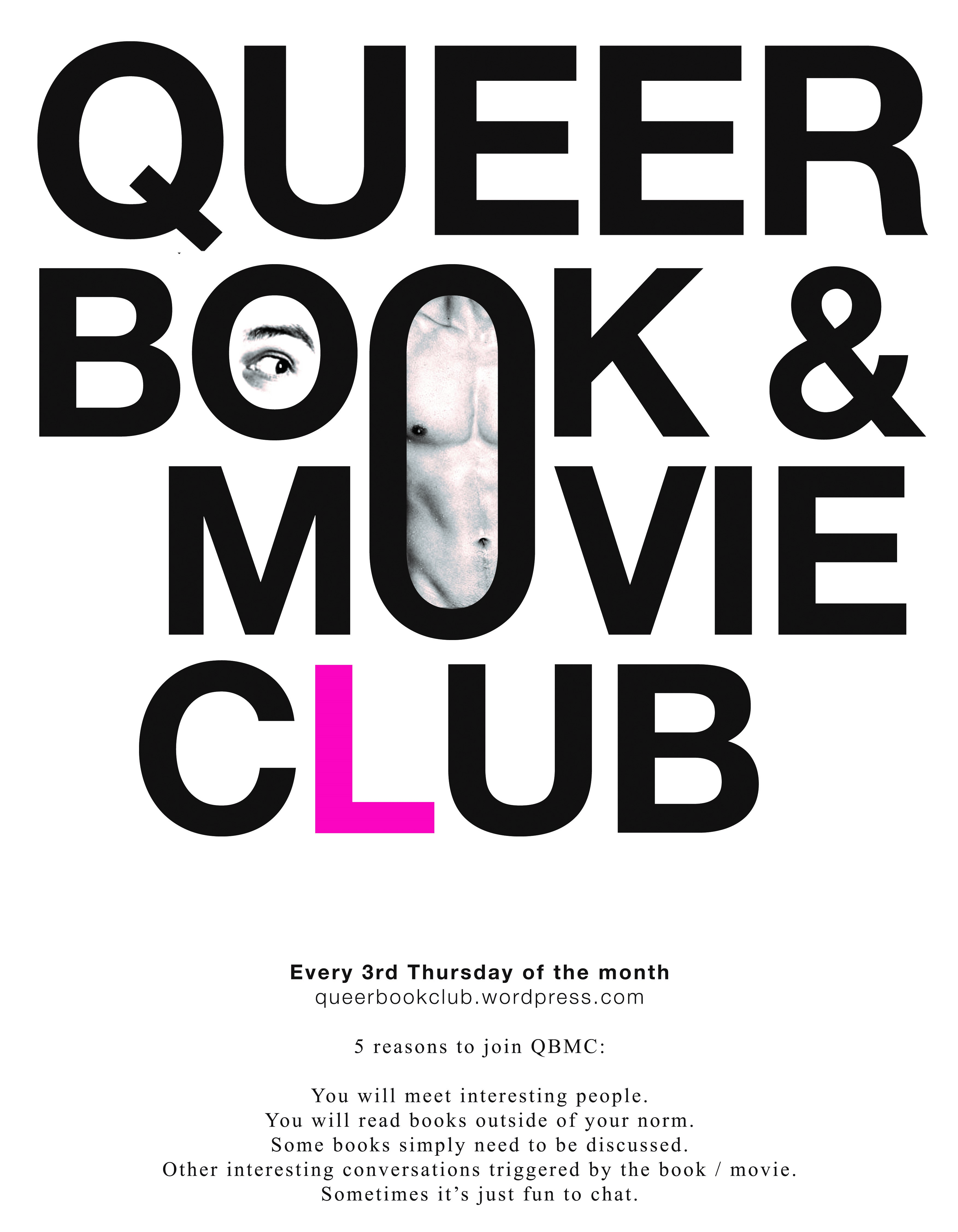
 Queer Book & Movie Club (Singapore)